


As the automotive industry embraces the future of connected vehicles, the Internet of Vehicles (IoV) is rapidly becoming a key driver of innovation. From navigation systems and autonomous driving technology to vehicle-to-everything (V2X) communication, the integration of wireless connectivity is transforming the way vehicles operate and interact with their environment. At the heart of this transformation is a crucial component: the antenna. Custom antennas are playing a pivotal role in enabling reliable, high-performance communication for vehicle navigation systems and the broader IoV ecosystem.
In this article, we will explore how custom antennas are enhancing the capabilities of vehicle navigation and IoV technologies. We will discuss the challenges and opportunities of antenna design in this context, the benefits of custom solutions, and how tailored antenna designs are enabling the next generation of smart, connected vehicles.
The Rise of the Internet of Vehicles (IoV)
The IoV refers to the network of connected vehicles that communicate with each other, infrastructure, and the cloud in real time. This communication ecosystem enables a wide range of applications, including real-time traffic updates, vehicle diagnostics, remote control and monitoring, and, eventually, autonomous driving.
One of the primary goals of IoV is to create a seamless flow of information that enhances safety, improves efficiency, and enables smarter transportation solutions. For this vision to be realized, vehicles need to maintain reliable, high-speed communication with a variety of systems, including GPS satellites, cellular networks, and other vehicles. The antennas that facilitate these connections must be able to support a wide range of frequencies and provide robust, interference-free communication in both urban and rural environments.
Antennas for Vehicle Navigation Systems
Vehicle navigation systems are some of the most well-known applications of wireless communication in the IoV. These systems rely on GPS signals to provide real-time location tracking, turn-by-turn directions, and route optimization. However, for navigation systems to work accurately and reliably, the antennas used in the vehicle must be designed to handle the challenges of automotive environments.
GPS Antennas for Precise Location Tracking
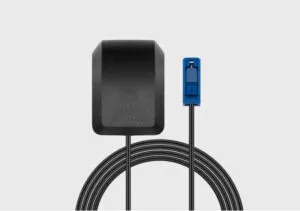
GPS navigation requires antennas that can receive signals from multiple satellites orbiting the Earth. These antennas need to be able to operate across the L1, L2, and L5 frequency bands (the primary frequencies used by GPS systems) with high sensitivity and low noise.
Custom GPS antennas can be designed to meet the specific requirements of automotive applications, ensuring that they can capture weak satellite signals while minimizing interference from other electronic components within the vehicle. In addition, the antenna must be durable enough to withstand the harsh conditions of the automotive environment, including vibrations, temperature fluctuations, and exposure to weather elements.
To optimize GPS performance in vehicles, antenna manufacturers may design specialized antennas that integrate multiple bands or even multi-constellation support (e.g., GLONASS, Galileo, and BeiDou) for enhanced accuracy and reliability. For example, a high-gain GPS antenna designed for vehicle navigation can improve signal reception, providing more accurate location data even in areas with poor satellite visibility, such as dense urban environments or mountainous regions.
Antennas for Real-Time Traffic Data and Connectivity
In addition to GPS, vehicle navigation systems rely on real-time traffic data to optimize routes and avoid congestion. This data typically comes from cellular networks (3G, 4G, and increasingly 5G), and antennas must be capable of supporting these high-speed communications with minimal latency.
Custom antennas designed for vehicle navigation systems may integrate multi-band capabilities to support both GPS and cellular communication, ensuring that vehicles can continuously receive real-time traffic updates. This is particularly important as the demand for high-speed, low-latency communication increases with the rollout of 5G networks. Custom-designed antennas that operate across multiple bands (e.g., 4G LTE and 5G) can ensure that vehicles maintain strong, stable connections with network towers, even while on the move.
Enabling Vehicle-to-Everything (V2X) Communication
Vehicle-to-Everything (V2X) communication refers to the ability of vehicles to communicate not only with each other but also with infrastructure (such as traffic lights and road signs), pedestrians, and the broader transportation network. V2X technology is essential for the development of autonomous vehicles and smart traffic systems, where vehicles need to exchange information in real time to make split-second decisions for safety, efficiency, and mobility.
V2X Antennas for Low-Latency Communication
V2X communication requires antennas that can support ultra-low latency, high-bandwidth communication with minimal interference. V2X networks rely on both dedicated short-range communications (DSRC) and cellular vehicle-to-everything (C-V2X) technologies. Each of these communication methods requires specific antenna designs.
- DSRC Antennas: DSRC operates in the 5.9 GHz frequency band and requires antennas that provide high directional gain and low latency to facilitate real-time data transmission between vehicles and infrastructure.
- C-V2X Antennas: C-V2X operates on the 4G and 5G cellular bands, requiring antennas that support multiple bands and provide stable communication even at high speeds. As 5G technology expands, custom antennas will need to support these high-frequency bands for low-latency, real-time vehicle communication.
By designing antennas that are optimized for these frequencies, manufacturers can ensure that V2X communication is fast, reliable, and efficient, helping vehicles make informed decisions about their environment, avoid collisions, and improve traffic flow.
Antennas for Cooperative Vehicle Systems
As autonomous and semi-autonomous vehicles become more prevalent, the need for cooperative vehicle systems will grow. These systems rely on V2X communication to allow vehicles to share information such as speed, position, and intentions (e.g., turning or braking) with other vehicles on the road. Custom antennas are crucial for enabling these cooperative systems, ensuring that vehicles maintain continuous communication with each other and avoid accidents.
For example, a vehicle with a custom-designed V2X antenna might be able to communicate with a neighboring car in a blind spot, warning the driver or autonomous system of a potential collision, even before the driver is aware of the danger. This type of communication relies on low-latency, high-bandwidth antennas that can operate in dynamic environments with minimal interference.
Antennas for Autonomous Vehicles
Autonomous vehicles (AVs) represent the next frontier in the evolution of transportation, relying on a combination of sensors, cameras, radar, and LIDAR systems to navigate and make decisions. These vehicles also depend heavily on reliable communication networks for coordination, navigation, and safety.
Antennas for Radar and LIDAR Systems
Radar and LIDAR systems are essential for detecting objects, mapping the surrounding environment, and guiding the vehicle’s movements. Custom antennas can be designed to work in conjunction with these systems, ensuring that radar and LIDAR sensors provide accurate data while minimizing interference from other vehicle electronics. These antennas must be able to support high frequencies and provide a wide range of coverage for precise sensor data collection.
Antennas for Vehicle Telemetry and Remote Monitoring
In addition to navigation and safety, autonomous vehicles rely on telemetry systems that collect data on vehicle performance, location, and status, transmitting it back to a central server for analysis and monitoring. Custom antennas are essential for ensuring these systems operate reliably, even when the vehicle is moving at high speeds or in remote locations where cellular connectivity may be weak.
Custom antennas designed for telemetry applications are optimized for both short-range and long-range communication, ensuring that autonomous vehicles can maintain connectivity for continuous monitoring and data transmission, improving safety and operational efficiency.
Conclusion
The Internet of Vehicles (IoV) is ushering in a new era of connected, intelligent transportation. From vehicle navigation and V2X communication to autonomous driving systems, custom antennas are at the heart of this transformation. These antennas enable reliable, high-performance communication between vehicles, infrastructure, and the cloud, making it possible for IoV technologies to work seamlessly and safely.
By designing custom antennas tailored to the specific requirements of vehicle navigation, V2X communication, and autonomous driving systems, manufacturers can enhance the performance, range, and efficiency of connected vehicles. As the IoV continues to evolve, custom antennas will remain a crucial component, driving innovation in transportation and helping to create smarter, safer, and more efficient roads for everyone.